Amazon FBA in 2026 is still one of the cleanest ways to build a real e-commerce business from a small starting budget. It is also the place where most beginners light $3,000 on fire on a single bad product and conclude that Amazon is rigged. Both things are true. The model works, and most people running it are doing exactly the moves that guarantee it will not work for them. Here is the full step-by-step done properly.
What FBA actually is, plainly
FBA stands for Fulfilment by Amazon. You ship your inventory to Amazon's warehouses. They store it, pick it, pack it, ship it, handle most returns, and take a fee for each step. You handle product sourcing, listing, ads and brand. Amazon handles the logistics.
In return for those fees - which add up to roughly 30-40% of your retail price when you stack referral, FBA pick-and-pack, and storage - you get access to Prime shipping, the Buy Box, Amazon's customer trust, and a fulfilment operation you could never build yourself at the same cost. For most beginners, FBA is the right choice over FBM (fulfilled by merchant). It removes the operational burden and lets you focus on product and marketing, which is where the actual money is decided.
The five-step path from zero to first sale
The whole FBA journey breaks cleanly into five steps. Most beginners try to do them in parallel. Do them in order.
Step 1: open and verify the Amazon seller account. Walked through in detail in how to open an Amazon seller account. This step is paperwork. Allow 1-2 weeks for verification and video call. Do not start sourcing products until the account is approved.
Step 2: research and pick a product. The single most important step in the whole process. Picked well, the rest is execution. Picked poorly, no amount of ad spend or photography saves you. Full breakdown in how to do product research for Amazon.
Step 3: source from a supplier. Order samples first. Negotiate MOQ and per-unit price. Get your branding on the product or at least the packaging.
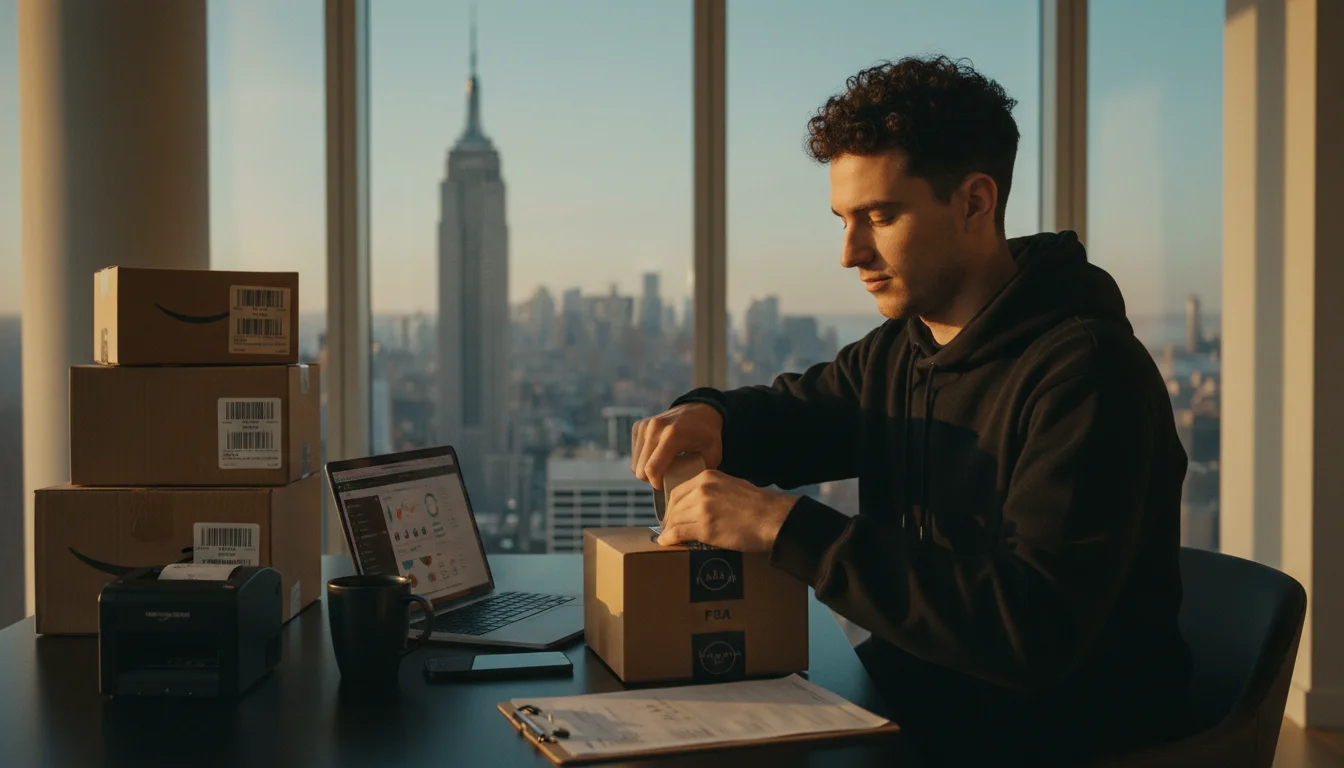
Step 4: build the listing and ship to FBA. Title, bullets, A+ content, photos, brand registry if you have it. Then create the inbound shipment in Seller Central and send the product to the assigned FBA warehouse.
Step 5: launch with paid ads. Sponsored Products at a minimum, ideally combined with Sponsored Brands once you have a few sales. The launch budget makes or breaks the listing's ranking. Full process in Amazon PPC for beginners.
Below I go deeper on each, with the actual numbers, fees, and traps.
Product picking - the four criteria
For a first FBA product in 2026, the criteria I would run any candidate through are these.
- Retail price between $25 and $50. Below $25, FBA fees eat too much of the margin. Above $50, ad cost to acquire a sale rises sharply and you need more cash to scale. The sweet spot for a first product is around $30-$40.
- Low return rate category. Avoid apparel, electronics, and anything fragile. Hardware, home goods, pet, hobby, kitchen, garden, sports - all generally fine. Returns kill margin twice (the refund plus the lost product) and Amazon penalizes high-return sellers.
- Existing demand visible. Use Keepa or Helium 10 to see that at least 5-10 listings in the category are doing 200+ units a month. If nobody is selling it, you are not the lucky exception, you are inventing demand without evidence. Re-pick.
- Differentiable. You should be able to add a small improvement or twist to the product - a bundle, a colour, a feature, a packaging upgrade. Selling the exact same product as everyone else means you compete only on price, and on Amazon that race ends with the cheapest seller.
Skip the trendy products on TikTok. By the time you can ship to FBA, the trend is past peak. Stick with boring evergreen categories where demand has been steady for years.
Suppliers - China still works if you do it right
For most FBA categories the supply chain still runs through China. The 2026 tariff hit dropshipping hard because it taxes small packages, but bulk shipments to FBA via sea freight are taxed differently and the per-unit duty is manageable. Most beginners ship 200-500 units in a first order, send it by sea (3-5 weeks) or air (5-10 days), and the duty is built into the unit cost when you do the maths.
The sourcing routes I would actually use:
Alibaba for finding the supplier. Filter by Gold Supplier and Trade Assurance. Message 10-15 suppliers with the same brief. Compare quotes, sample quality and response time. Pick two, order a sample from each. Pay the small extra for sample quality - it tells you everything you need about how production will go.
An agent in Yiwu or Shenzhen if you want extra hand-holding, custom packaging, or quality inspection. Costs 5-10% above factory price, removes 90% of the headaches. For a first product, an agent is worth it.
Direct US suppliers if you want to avoid the China question entirely. Higher unit cost, faster restocking, easier conversations. Some categories are well-served by US wholesalers, others are not.
Either way, order samples first. Hold the product. Photograph it on your own desk. If the supplier cannot make you happy, your customer will be furious. I went deeper into the actual vetting checklist in how to find suppliers for your store.
The supplier you want is not on the first page of Google. You will email 30 of them and one will change your business.
FBA fees - the maths you have to do before you order
Before you ship a single unit to FBA, do this calculation honestly.
Retail price: $34.99 (example). Amazon referral fee (most categories): 15% = $5.25. FBA pick-and-pack fee for a small standard item: ~$3.75. Storage fee (monthly): ~$0.50 if normal velocity, more if slow-moving. Cost of goods including duty and inbound shipping: $7. Brand and packaging: ~$1 amortized. Returns reserve at 5%: $1.75. Estimated PPC cost to acquire one sale: ~$5 (this is the big variable).
Profit per unit before tax: $34.99 - $5.25 - $3.75 - $0.50 - $7 - $1 - $1.75 - $5 = ~$10.74 (about 31% margin). Acceptable. Below $7 per unit, the product is borderline. Below $5, walk away.
Do this maths before you order. Most beginners do it after the inventory has shipped and discover that the product was never going to be profitable. The order in which you do these checks decides everything.
Building the listing
The listing is where Amazon SEO and conversion meet. Both have to be optimised at the same time, because ranking does not convert and converting does not rank.
Title: keyword-rich but readable. The main keyword in the first 40 characters. Brand name first. Concrete benefit or attribute next. Avoid the "stuff-every-keyword-in" approach - Amazon's algorithm now penalizes that. Aim for 150-180 characters of useful information.
Bullets: five of them. Each one starts with a capitalized benefit (the "what is in it for me"), then explains the feature behind the benefit. Not "100% cotton material" - "Comfortable through summer heat. Crafted from breathable 100% cotton."
Photos: seven images, all 2000x2000 minimum. Main image on white background showing the product clearly. Then lifestyle, then infographic, then scale shot, then close-up, then social proof or comparison, then video if you have one. Photos are 60-70% of conversion. Pay for them. Or generate them in AI and have a human retouch.
A+ content: only available with Brand Registry. Worth the trademark process if you are building a brand. Lifts conversion 5-15% on top of the main listing. Detail breakdowns in the listings-that-convert article.
Pricing: at launch, price slightly above your competitor average - never below. Below tells Amazon you are racing to the bottom. Above tells Amazon you believe in your product. The Buy Box does not always go to the cheapest seller.
Launch - the PPC ramp
Launch is where your hard-earned listing rises or sinks. The mechanism is simple - sales velocity in the first 7-14 days tells Amazon your listing is relevant, and Amazon rewards relevance with organic ranking. So you need sales fast. Paid ads are the lever.
The structure I run on every launch:
One Sponsored Products campaign with Automatic Targeting at a moderate bid. Lets Amazon find what queries you actually convert on. Run for 14 days, then mine the search term report for winning keywords.
One Sponsored Products campaign with Manual Targeting on Exact match for your main keyword and 3-5 closely related variants. Aggressive bid to win impressions. This is your spearhead.
One Sponsored Products campaign with Manual Targeting on Broad and Phrase for the top 10 keywords from your research. Wider net for ranking.
Budget: $20-$40 a day to start, scaling to $50-$80 a day once you have one campaign converting. First week ACoS (Advertising Cost of Sale) will be ugly, often 50-80%. Do not panic. The job in week one is ranking, not profitability. Profitability comes in week 4-6 as organic sales start mixing in.
If after 14 days the listing is converting under 4% and you have spent $300+, something is wrong with the listing or the product itself, not the ads. Pause and diagnose. The right move is rarely "add more budget" at that point.
Common beginner mistakes
The ones I see most:
- Too small a first order. Beginners ship 100 units to be safe. Then they sell out in 3 weeks and lose the ranking they paid PPC to build. Order 300-500 units for a first batch in most categories.
- No Brand Registry. Trademarking takes time and feels expensive, but without it you have no defense against hijackers and no A+ content. Start the trademark in parallel with sourcing.
- Bad photos at launch. "I will upgrade the photos later when I have money." Wrong. The photos at launch decide whether you get to "later". Spend on photos before you spend on ads.
- Ignoring reviews. Three reviews can move a product. Vine, Request a Review automation, packaging inserts that ask politely. Get reviews from day one in compliance with TOS. I covered this in how to get reviews on Amazon legally.
- Panicking on suspensions. Suspensions happen. They are recoverable. Read the policy violation email three times before replying. Reply professionally with a Plan of Action document. Most first-time suspensions resolve within a week if handled correctly.
The honest budget for a real FBA start
If I were starting from zero in 2026, I would budget the following before shipping any inventory.
$300 - Amazon Professional plan for 8 months ($40/month).
$200 - product samples from 2-3 suppliers.
$2,500-$4,500 - first inventory order (300-500 units at $7-$10 per unit, plus duty and inbound shipping).
$400-$800 - photography or AI photo + retouching budget.
$300-$500 - trademark filing.
$1,000-$2,000 - PPC launch budget for the first 30 days.
Total realistic minimum: about $4,800-$8,500. Lower than that exists but every dollar you skip raises the risk of the first product being a write-off. Do not skip photography or PPC budget specifically. Both are non-negotiable if you want a real shot.
What to expect in the first 90 days
Realistically, the first 30 days you are spending money to build ranking. ACoS is high, profit is negative. The second 30 days, ad costs settle, organic sales start, ACoS drops to 20-35%. The third 30 days, you should be moderately profitable on the first product and considering the next SKU.
Most products that work have crossed into clear profitability by day 60-90. If yours has not by day 120, do an honest review of whether the product itself was wrong. Not every product is a winner. The winners pay for the losers. The skill is recognizing the losers fast.
For the full FBA playbook end to end - product picks, supplier scripts, listing templates, ad structures and the cash-flow model - that is the spine of the Amazon module in the full course. Open the account this week. Pick the product next week. Order the sample the week after. Shipping inventory in 60 days is realistic if you keep moving.