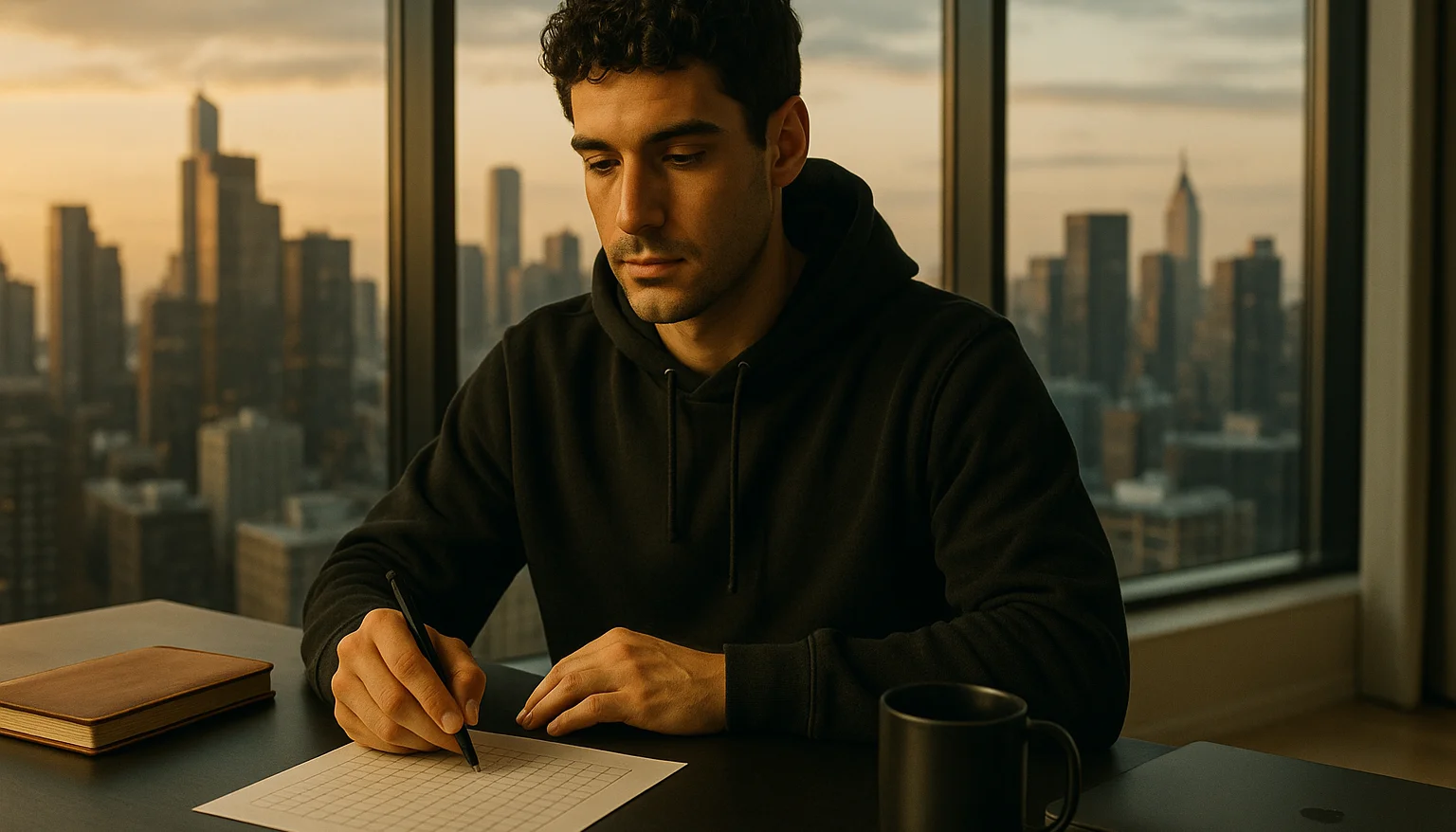
Goals without a vision are random sprints. You hit the goal, look around, and realize you have arrived somewhere you did not really want to be. The vision gives the goals direction. The 90-minute exercise below is what produced my own 10-year north star at 21, and what I have walked over 100 students through since. It is not abstract. The output is concrete enough to act on Monday.
What a vision is and is not
A vision is not "I want to be successful". That is too vague.
A vision is not "I want $1M in net worth". That is a number, not a life. Vision tells you what the $1M is for.
A vision is a specific portrait of how your life looks, feels, and operates 5-10 years from now. Specific enough that you can walk through a typical Tuesday in that future life and feel what it is like.
That specificity is the magic. Vague visions do not pull you. Specific visions do.
The 90-minute exercise
Block 90 minutes. Quiet room. Notebook. Pen.
Phase 1 (30 minutes) - draft the Tuesday
Pick a specific date 7 years from now. A Tuesday in early September. Write down, in present tense, what that day looks like for you.
Where do you wake up? What time? Who is in the house? What is the first thing you do in the morning? What does breakfast look like? What is on the schedule for the day? Where do you work? What kind of work? With whom? What time do you stop working? What does the evening look like?
Be concrete. "I wake up at 6:30am in a house with high ceilings near a body of water. My partner is downstairs making coffee. The dog is asleep at the foot of the bed."
If the words sound like a magazine profile, you are on track. If they sound like a generic affirmation, push for more specificity.
30 minutes of writing. Do not stop to edit. Just write.
Phase 2 (20 minutes) - extract the variables
From the Tuesday, extract the variables that define it. Things like:
Where you live (city, town, country).
Who is in your life day-to-day.
What you do for income.
What time and energy you control vs. what is controlled by others.
How wealth shows up (or does not).
What kind of work feels rewarding.
What is missing that you wish was there.
Write each variable on its own line. 7-12 variables typically emerge.
Phase 3 (20 minutes) - back-derive the 3-year
For each variable, ask: where would I need to be 3 years from now to be on track for the 7-year Tuesday?
The 7-year house in the woods requires the 3-year version of the business that pays for it. The 7-year partner stability requires the 3-year work on that relationship. The 7-year ability to take 2-month sabbaticals requires the 3-year business that can run without you for that long.
Write the 3-year version of each variable.
Phase 4 (20 minutes) - the next 12 months
From the 3-year version, back-derive what the next 12 months need to produce.
If the 3-year business needs to generate $30K/month, the next 12 months need to produce something specific - product market fit, the first $5K month, the operational system.
If the 3-year partner stability requires specific things, the next 12 months need specific work on those things.
Write the 12-month deliverables. 4-7 specific items.
These become the goals you actually work toward in the next year. They are derived from the Tuesday, which is derived from your honest answer about what life you want.
The Tuesday is not a fantasy. It is a destination. Most people set goals without destinations and then wonder why they feel lost after achieving them.
What changes after the exercise
Three things shift.
One - the goals feel different. Working toward "$30K/month" is abstract. Working toward "the version of me who hits $30K/month so I can move to that house in 3 years" is concrete. The same dollar number, completely different motivational architecture.
Two - certain previously-attractive opportunities lose their pull. The job offer that pays more but moves you to a city you do not want to live in suddenly looks wrong, because the vision has revealed the city as a key variable.
Three - the daily choices align. The morning routine, the gym schedule, the people you spend time with - these get evaluated against whether they move you toward the Tuesday or away from it.
How often to re-run it
The first version of the exercise is often partial. You will write the Tuesday and feel that something is missing or off. That is normal. The honest version comes through revision.
Re-run the full exercise once a year, in the same season. Compare to last year's version. Notice what stayed, what changed, what got more specific.
The vision evolves with you. The act of revisiting it is part of the practice.
What does not work
Doing the exercise once and never returning. The vision becomes stale. Without periodic refresh, the connection to daily action erodes.
Treating the exercise as fantasy. The Tuesday should feel possible. If it feels like a movie scene, push to a version you would actually accept as your real life.
Skipping the back-derivation. Many people write the 7-year Tuesday and stop. The Tuesday alone does not change behavior. The link to 12-month deliverables is what changes behavior.
Comparing your Tuesday to other people's Tuesdays. Yours should be yours. Other people's Tuesdays are theirs.
For the broader mindset architecture, read how to set goals that actually get achieved and how to visualize success. The full vision-and-goals module is the spine of the planning material in the course. Block 90 minutes this weekend. The Tuesday. Then the rest.