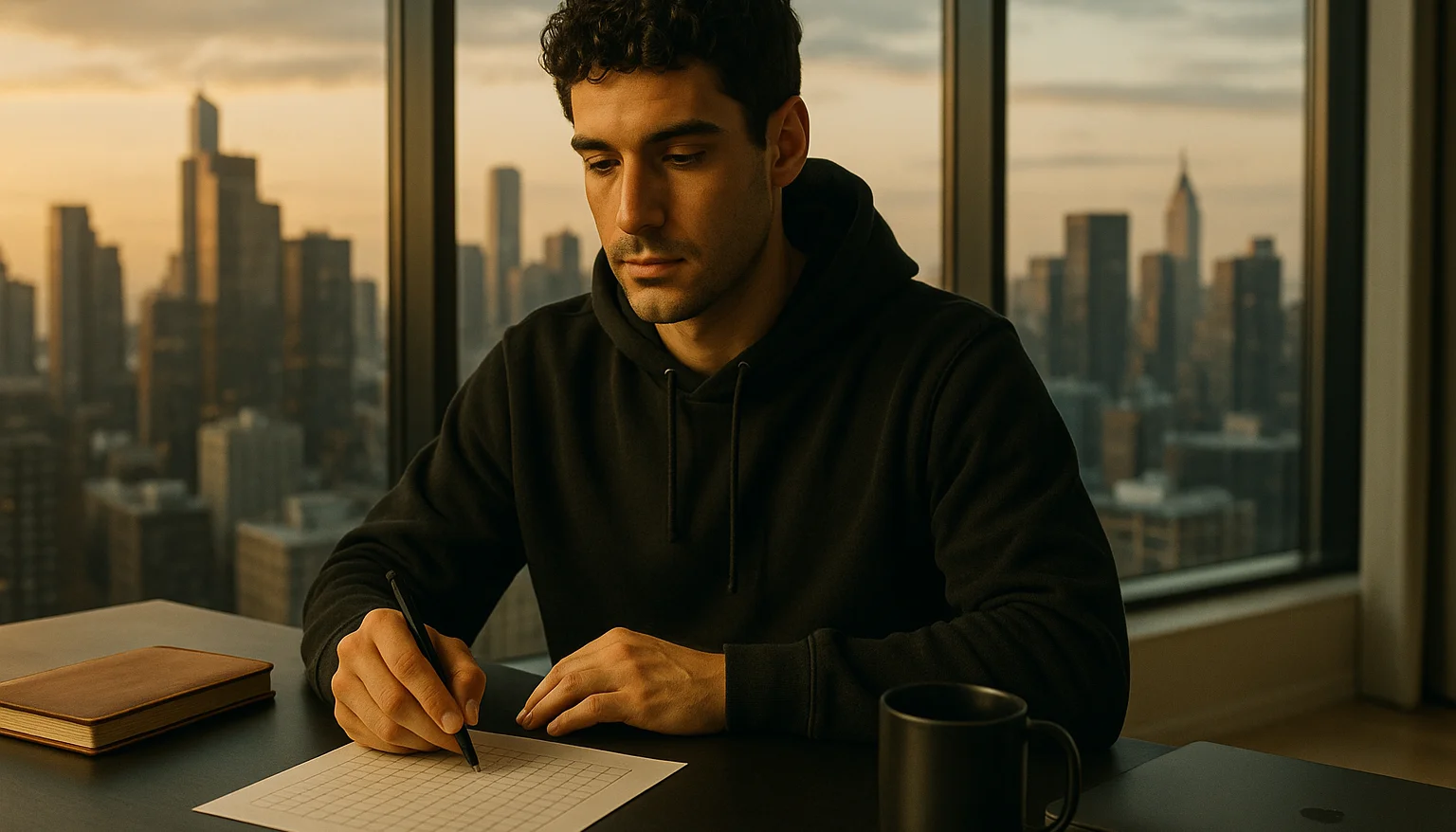
Most morning routine content on the internet is written by people whose job is to write morning routine content. The 5am club, ice baths, 60-minute meditations, journaling rituals, three separate types of breathing exercises before breakfast. Total time: about 4 hours before any real work begins. Total impact on actual business outcomes: minimal.
This article is about the morning routine that actually builds an entrepreneur. It is shorter than most, it survives bad nights and sick kids and travel, and it is built backwards from the one thing that matters in the early years - getting the right work done while the brain is sharpest. Everything else is decoration.
The principle - protect the first 90 minutes
The first 90-120 minutes after waking are when your prefrontal cortex is most coherent and your willpower is at maximum. This is where the hardest, most creative, most leverage-heavy work of the day should happen.
Most people throw away this window on email, Slack, social media, and decisions about what to wear or eat. By the time they sit down to the real work at 11am, the best hours of cognition are gone, willpower has burned on 200 small decisions, and the rest of the day is downhill.
Everything in the morning routine below is a tool for protecting that 90-minute window. If a ritual does not serve that protection, it does not belong.
The actual routine
Time of waking: not 5am. Whatever time gives you 7-8 hours of sleep based on when you went to bed. Sleep is non-negotiable. I covered the full breakdown in how to sleep better when building a business. If you have to choose between waking at 5am and getting 7 hours, get the 7 hours every time.
Step 1: light. Immediately. Get bright light on your eyes within 10 minutes of waking. If you can walk outside, even better. Five minutes of morning sunlight calibrates the circadian rhythm and shuts down melatonin. This is the single highest-ROI move in any morning routine, and it costs nothing.
Step 2: water. Immediately. A large glass before anything else. Your body is mildly dehydrated after sleep. This is mechanical, not spiritual.
Step 3: no phone for the first 30 minutes. The single hardest part for most people. Once you check the phone, you have entered other people's priorities, and your willpower budget starts draining on responses. If you can hold off the phone for 30 minutes, you get the first 30 minutes of your own day.
Step 4: open the laptop and start the one task. No coffee yet, no shower yet, no journaling. The task that, if it gets done today, makes the rest of the day worth something - that task gets the first hour. Cold start, slightly uncomfortable for the first 10 minutes, then locks in.
If you are wondering "what about coffee", coffee is fine but make it after starting. The 10-minute lag while you sit down and start working before the coffee arrives is the most important 10 minutes of your morning. Reverse the order and you train your brain that you cannot start without coffee, which is a small daily fragility.
Step 5: about 75-90 minutes in, take the first break. Now the gym, the shower, the breakfast, the proper morning. By this point the hardest work of the day is done. The rest of the day is execution and operational, both of which need less of your sharpest cognition.
What the routine deliberately leaves out
No 5am wake-up. Sleep first.
No 30-minute meditation. Useful if you have an existing practice, optional for builders. The 5 minutes of light exposure does a lot of the same nervous-system work.
No elaborate journaling. If you journal, do it in the evening to clear the next day, not in the morning to delay it.
No cold plunge. Cold showers are fine after the morning routine, not before it. Same nervous-system benefit, much lower setup cost.
No "morning pages", manifestation, gratitude lists, intention-setting. These activities migrate naturally into evening routines or weekly reflections, not into the time when you have your peak cognition for work.
What it looks like in practice
6:45am - wake (after 7 hours of sleep).
6:46-6:50 - light exposure (window or short walk), water.
6:50-6:55 - dress in pre-laid-out clothes. No decisions.
6:55-7:00 - sit at desk, open laptop, no phone yet, open the one task doc.
7:00-8:30 - the one task. Coffee at some point in this window when you make it without leaving the desk.
8:30-9:00 - first break. Shower, breakfast, check messages briefly.
9:00 onward - the day's operational work, meetings, customer messages, ads, the rest.
Total ritual time before "real work": about 15 minutes. Total productive output by 8:30: more than most people get done all day.
An arrow flying towards its target doesn't get distracted by the scenery.
The hardest part
The hardest part is the no-phone-for-30-minutes rule. The phone is the single most efficient willpower drainer in modern life. Once you open it, you have spent ten small portions of your morning willpower on reactions to other people's content, before you have spent any on your own work.
If you do nothing else from this article, just delay the phone by 30 minutes for 7 days. Notice what changes. Most people who try it report a steadier morning and an easier start to the work day, not because the phone is evil but because your day is now starting on your own terms.
Why it works for entrepreneurs specifically
Employees have the luxury of low-leverage hours. They can do the hard tasks anytime, because no one specific hour decides the business outcome. Entrepreneurs do not have that luxury. The 90 minutes of best cognition is most of the leverage. Spend it on email and you have given away the best part of your day for the worst payoff.
Successful builders I have sat with all run some version of this routine, even if they do not call it that. The shape is always the same. Wake naturally. Light. Water. Start the hardest task before the world wakes up. Everything else is decoration.
How to install it
The same way you install any habit. Start with one component. The light exposure is the easiest first move - it requires no behaviour change other than walking to a window. Run that for two weeks. Add the no-phone rule. Run for two weeks. Add the immediate-start-on-task rule. Now you have a routine.
Total installation time: 6 weeks. The benefits start showing up in the first week and compound from there.
What to expect
Week 1: you will hate the no-phone rule. Do it anyway.
Week 2: the no-phone rule starts feeling natural. The "start without coffee" rule will feel like the hard part now.
Week 3: the routine runs without you deciding. You wake up and the sequence happens.
Week 4 onwards: your daily output on the hard tasks roughly doubles, because you have stopped feeding your best cognition to other people's priorities.
For the broader system - deep work, time blocking, sleep, focus - read deep work for entrepreneurs in 2026, the complete guide to time blocking for solopreneurs, and how to build discipline when you have no motivation. The full discipline and productivity stack is the spine of the operations module in the course. Light, water, the one task, no phone. Tomorrow morning. That is all you owe yourself.