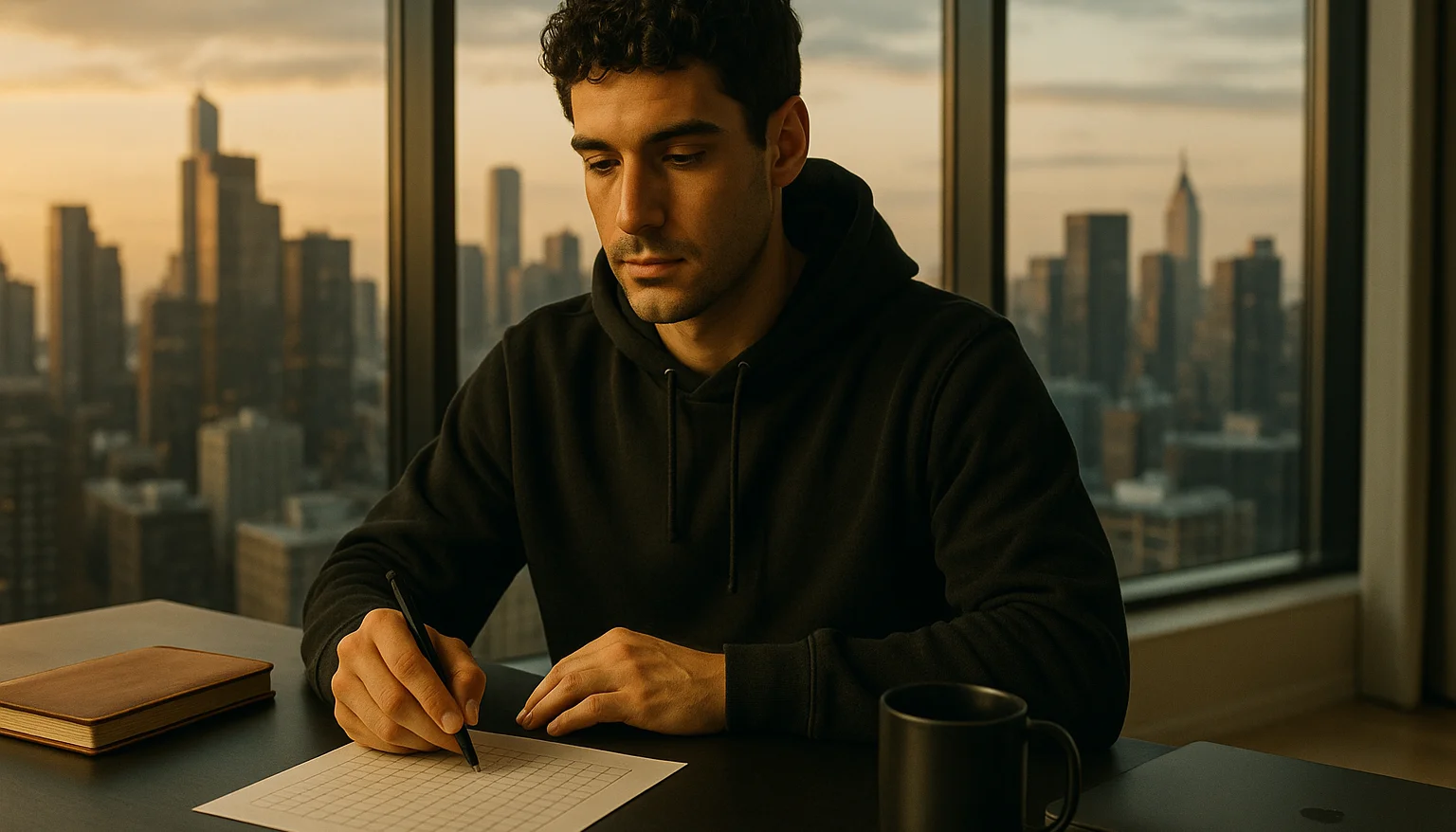
A 4-minute end-of-day ritual produces about 90 minutes of additional output the next morning. The math is absurd. The cost is trivial. The reason most people skip it is that the benefit is invisible until you have done it for two weeks.
What goes wrong without it
You wake up at 7am. You sit at the laptop. You ask the first question - "what should I work on first?" The brain, which has just woken up, is now spending its peak willpower on a decision instead of on the work itself.
By the time you have decided what to work on, opened the right document, remembered where you left off yesterday, and gotten into the rhythm, 30-45 minutes have passed. The day's hardest cognitive work is now happening at 30% willpower instead of 95%.
This pattern repeats five mornings a week. Across a year that is ~120 hours of best cognitive energy thrown away on the question "what should I work on this morning".
The four questions
The night before, four questions get answered. The answers are written, not just thought.
One - what is the single most important task to do tomorrow morning?
Two - exactly where do I pick it up? What file, what tab, what paragraph, what step.
Three - what could derail it, and how will I handle that?
Four - what is the next task if the first one finishes early?
Four answers. Four minutes. Done.
The next morning, you sit down, glance at the answers, open the right thing, and start. No decision spent. No willpower wasted. The 90 minutes of peak cognition go straight into the work.
How to set it up
Pick a fixed time. Mine is right after dinner before any TV or social. Yours could be just before bed, or at the end of the work day. The exact time matters less than the consistency.
Pick a fixed place. The notebook on the desk. The notes app. Wherever you will see it first thing in the morning.
Use the same four questions every night. The repetition is what makes it work. Variations dilute the protocol.
Four minutes. No journaling. No long reflection. Just the four answers in writing.
How do you move fast? Plan slowly the night before. Then move fast in the morning.
The bigger payoff
Beyond the morning output gain, the night-before plan does two other things.
One - the brain works on the task overnight. You will sometimes wake up with the answer to a problem you wrote down. The unconscious processes the task while you sleep.
Two - the daily stress drops. You go to bed knowing exactly what tomorrow morning looks like. The vague "I have so much to do" anxiety is replaced by specific concrete intent. Sleep quality often improves.
Both of these are bonus effects. The main effect - the 90 minutes of better morning output - is enough on its own.
What to write for question 1
The single most important task tomorrow should pass two filters.
Filter one - it advances the actual business or life goal, not just operational maintenance. Not "answer the supplier email". Something like "write the launch plan for the new product" or "draft the next month's content calendar".
Filter two - it is specific enough to start in 30 seconds. Not "work on the business". "Write the first 500 words of the brand story page".
If the task does not pass both filters, refine it until it does. Vague tasks the night before become 45-minute warm-ups the next morning.
What to write for question 2
This is the "drop pin" question. Exactly where you will pick up. The specific document name. The specific section. The specific line.
This is the part most people skip. Without it, the morning starts with "okay now where was that document I was working on yesterday". Five minutes of searching, scrolling, finding. The cost is the morning's freshness.
With it, the document is named, the tab is queued, you open and resume in 30 seconds.
What to write for question 3
This is the disruption-plan. What might come up tomorrow morning that could pull you off the main task. The supplier might reply with a question. The ad account might flag something. A customer might message about an urgent return.
Write one sentence about how you will handle each likely disruption without abandoning the main task. Usually the answer is "I will deal with this at 11am, not before". Pre-deciding the boundary makes it stick when the moment comes.
What to write for question 4
The next task. The one after the morning's main task. So that when you finish the first thing 90 minutes in, you do not pause to decide what to do next - you just go.
Three or four queued tasks for the day is enough. Past four, you are over-planning and the plan becomes brittle. Most days you will not finish three things. That is fine. The queue just exists so you never sit at the desk wondering.
The two-week proof
Run this protocol for two weeks. Log how the mornings go. Most operators see a noticeable jump in morning output within the first 5 days. By day 14 the protocol is automatic and the benefits are obvious.
If you skip days, the difference between protocol-days and skip-days is striking. The skip-day mornings feel sluggish and unfocused. The protocol-day mornings feel sharp.
This is one of the lowest-cost, highest-impact moves I know in operator productivity.
For the broader operations layer, read the morning routine that builds an entrepreneur and time blocking for solopreneurs. The full operations module is in the course. Four questions tonight. Four minutes. Tomorrow morning starts different.