You have a job. You come home tired. You have maybe a few hundred dollars you would not cry over losing, and you want to sell something online without filling your apartment with boxes you might never sell. That is the exact spot print on demand was built for.
Print on demand for beginners gets sold as a magic button. It is not. But it is one of the cleanest ways to start a real online business right now with almost no money on the table, and I want to walk you through what it actually is, what the catch is, and how you start without lying to yourself.
I have started from zero twice. Once at 28, in the US, with no English and no savings. I know what it feels like to want a business but not have room to make a mistake that costs real money. Print on demand removes most of that risk. It does not remove the work.
What print on demand actually is
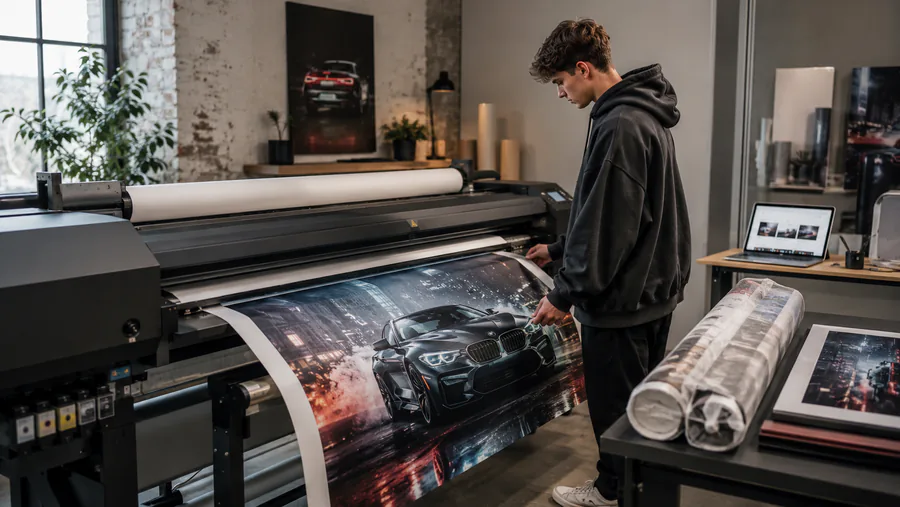
Here is the whole thing in one paragraph. You make a design - a phrase, an image, a piece of art. You upload it to a print partner. That partner has a catalog of blank products: mugs, t-shirts, hoodies, posters, phone cases. You put your design on the products you choose and you list them in your store. Nothing gets printed yet. Then a customer buys. Only at that moment does the partner print your design on the mug, pack it, and ship it to the customer with your name on the package. You never touch the product. You never see it.
That is it. No warehouse. No stack of unsold shirts in sizes nobody wanted. The product is made only after a customer pays for it, which means you are not gambling your rent money on guessing demand.
Why print on demand for beginners makes sense right now
Two reasons, and the second one changed in 2026, so pay attention.
First, the money. With normal product businesses you buy stock up front. You order 200 units, the box arrives, and now you are praying. With print on demand you spend close to nothing before your first sale. You pay for the product only when someone already paid you for it. For a person with a day job and a small budget, that difference is everything. You can be wrong ten times and not go broke.
Second, the tariff thing. For years the standard beginner move was cheap dropshipping from China - order a $2 gadget, sell it for $15, ship it slow. That math broke. Since early 2026, low-value postal packages coming from China into the US get hit with an import duty of roughly 54 percent, or around $100 per package, whichever applies. The cheap-China model that depended on tiny untaxed parcels got a lot uglier overnight. Meanwhile print on demand partners print inside the US for US customers. That tariff does not land on you the same way. So print on demand quietly became the more sane starting point for beginners with little cash. I wrote a full breakdown of where dropshipping stands now in is dropshipping dead in 2026 - read it if you are torn between the two models.
Print on demand vs dropshipping, honestly
People want me to crown a winner. I will give you the real trade-off instead.
Cheap dropshipping wins on cost per item. You buy a thing for almost nothing and the margin per sale looks fat on paper. But you are selling the same generic product as 400 other stores who can all get it from the same supplier. So you fight on price. Someone drops their price, you drop yours, and you keep dropping until there is no profit left. That is the race to the bottom, and the bottom is where most dropshipping stores die.
Print on demand costs you more per item. A blank shirt plus printing might run you 12 to 15 dollars before you have made a cent. That is the honest downside. But here is what you get for that money: you are not selling a generic thing. You are selling your design, your brand, your niche. Nobody else has your exact shirt. They cannot undercut you on a product that only exists in your store. You compete on how good the design is and how well it speaks to a specific group of people, not on who can shave another fifty cents.
Competition means customers exist in this niche. You just need to do a little better.
That is the print on demand vs dropshipping question settled the way I see it. Dropshipping rents you a commodity. Print on demand lets you build something that is actually yours. For a beginner who wants to still be standing in a year, the second one is worth the higher cost per item.
The catch nobody tells beginners
Now the part that gets skipped in every shiny print on demand video. Print on demand lives or dies on two things: the design and the niche. That is the whole game. The mug is a mug. The shirt is a shirt. The print partner is just a printer. What makes money is what you put on it and who you put it in front of.
A generic "funny cat" t-shirt sells nothing. Zero. There are a million of them, none of them mean anything to anybody, and the algorithm has no reason to show yours. A shirt with an inside joke that only nurses who work night shifts would get - that sells. Because a night-shift nurse sees it, feels seen, and buys it for herself and two coworkers. Same blank shirt. Completely different result.
So when someone tells you print on demand failed for them, ask what they sold. Almost always it was generic designs aimed at nobody in particular. The model did not fail. The aim did. If you ignore this, the rest of the steps below will not save you.
How to actually start print on demand
Here is the order I would do it in. Not flashy, just effective.
Pick a real niche first. Not "clothes." Not "home decor." A specific group of people who already buy stuff to signal who they are. Dog owners of one breed. People into a particular hobby. A profession with strong identity. Fans of a small town. You want a niche with a real community behind it, because communities buy things that say "this is me." If you cannot picture the exact person who buys your shirt, your niche is too wide.
Make the designs with AI. This is the part that used to stop everyone. "I am not a designer." You do not have to be anymore. AI image tools like Midjourney can produce design work that is genuinely good enough to sell, and you direct them with words. You become the art director, not the artist. I use these tools across my own stores every day, and I broke down exactly how in how I use AI in ecommerce. The not-a-designer excuse died a couple of years ago. Let it go.
Choose a print partner. Printify, Printful and similar services are the standard. They handle the printing, packing and shipping. Compare them on product quality, print quality and base price, order a sample of your own design before you trust them with customers, and pick one. Do not overthink this for three weeks. It is a printer.
List it somewhere. Two main paths. Etsy, where buyers are already there searching, which is the easier first sale for most beginners - I walk through the whole setup in how to start an Etsy shop. Or your own store, where you keep more control and more margin but you have to bring your own traffic. Most people should start on Etsy, learn what sells, then add their own store later.
Price for a real margin. Your product costs you, say, 14 dollars all in. Do not list it at 19 and call it a business. After the platform fee and the inevitable refund, you made nothing. Price it where there is actual profit after every cost is counted - fees, the product, shipping, the occasional return. With print on demand you are not the cheap option, so stop pricing like you are.
The honest expectations
Print on demand is not free money and it is not passive. Anyone selling it that way is selling you a feeling, not a business. What it really is: design work plus marketing. You make designs people in your niche actually want, and you get those designs in front of those people. That is the job. The print partner just removed the warehouse and the upfront cash risk so you can do that job without betting your savings.
A realistic first sale comes after two to four weeks of real effort. Not two to four weeks of watching videos - two to four weeks of making designs, listing them, and adjusting. Your first designs will probably be mediocre. Mine were. You make more. You learn which ones move and which ones sit there, and you make more of the kind that move.
How do you move fast? Move slowly, but do it every single day.
That line is the whole strategy. A few designs a week, listed properly, aimed at a niche you actually understand. Do that for three months and you will have a small catalog that teaches you what works. Do it for a year and you have a real brand. If you want the full path - niche research, the AI tools, pricing, the platforms side by side - that is what the full course is built to walk you through, step by step.
Print on demand for beginners is not the easiest thing on earth. It is just one of the few honest ones - low money down, no inventory, and a result that actually belongs to you. Pick a niche this week. Make one design. Start.